
ABSTRACT :
FULL TEXT :
INTRODUCTION: TO LIVE IN DIGNITY OR INDIGNITY?1
‘Winning the Human Race Against Time’ was the title of a conversation that the important global thinker and former head of the Club of Rome, His Royal Highness Prince El Hassan bin Talal of Jordan, conducted on 28th June 2022 with Mark Green, the President of the Wilson Centre, a think tank that informs public policy and is based in Washington, DC, United States. This conversation was introduced with the following sentences, ‘West Asia-North Africa is in a race against time. Within the next thirty years, increasing air pollution and climate change-induced heatwaves and droughts will push the region closer to uninhabitability, triggering unprecedented levels of human insecurity and large-scale displacement’. 2
Not just the Levante, all over the globe, we live in historical times where we see an intensification of systemic sociocide and ecocide. The suffix- cide stems from Latin -cida and the verb caedo, caedes, caedere, caedi, caedum. Words such as genocide, suicide, or pesticide all end with -cide, all conveying the meaning of ‘killing’. Ecocide is the ‘killing’ of the ecosphere, of the ecological world3 ‘of which we humans are but a small part, despite their belief to be its masters’.4 Ecocide is the deliberate and widespread destruction of ecosystems, natural resources, and biodiversity, encompassing actions such as deforestation, pollution, and habitat destruction that have severe and lasting consequences for the planet, including species extinction and climate collapse. Sociocide shares a similar concept, pointing at the ‘killing’ of the sociosphere, the destruction or harm inflicted upon societies, cultures, or social structures. Sociocide is the wearing down of the fabric of a community or society, the corrosion of the social ‘glue’ that keeps human communities together, a disintegration that is caused by systemic frames that spawn everything from a loneliness epidemic to hate speech and war. Sociocide and ecocide together manifest within long-standing entrenched systems of degradation, systems of humiliation that are congealed into institutions, similar to how apartheid operated in South Africa.
Ecocide and sociocide are facilitated by the same underlying catalyst, namely, cogitocide. The term cogitocide was coined in 2020 by Prince El Hassan bin Talal of Jordan.5 Cogito comes from cogitare in Latin, ‘to think’,6 and cogitocide means the killing of our cogitosphere, the killing of ‘the realm of thinking and reflection’,7 the drowning of people’s minds in a sightless infosphere.8 Lindner considers cogitocide to be the very ‘weapon’ that is being used to maintain systems of humiliation.9
The following question arises: In the face of this grave situation, what kinds of futures are in store for humanity? After nearly fifty years of research and practice on all continents, Lindner suggests that there are four possible scenarios, as shown in Table 1.
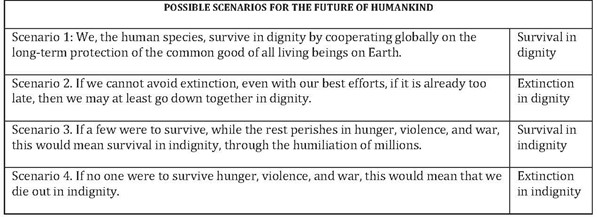
Table 1, four scenarios as envisioned by Evelin Lindner, 2022
Evelin Lindner works for the first scenario, and, only if unavoidable, for the second. Her aim is to avoid the last two scenarios. Her lifelong quest has been to determine what would be needed to manifest the first scenario. Over the past decades, she has developed a model that embeds the notion of dignity — together with its violation, humiliation — within a larger historical context.10 This model sheds light on the reasons for why dignity is so difficult to conceptualise, which may explain why the Universal Declaration of Human Rights that was adopted in 1948 was not called Universal Declaration of Human Dignity, despite the fact that dignity comes first in its foundational sentence, namely, that ‘all human beings are born equal in dignity and rights’.
The article begins by asking, ‘What if dignity is a useless concept?’, followed by the question, ‘What if different concepts of dignity are incompatible with each other?’ Then the article presents the author’s defence of the notion of dignity and summarises how she embeds it in the larger historical trajectory of humanity as a species. The significance of the notion of dignity is highlighted not least by the efforts of His Royal Highness Prince El Hassan bin Talal of Jordan, a leader in the cause of peace and inter-faith understanding. He has for several decades been ahead of his time in advocating for dignity. The article ends with a call for renewed attention to global systemic change so humanity may face a future of dignity.
WHAT IF DIGNITY IS A USELESS CONCEPT?11
For philosopher Arthur Schopenhauer (1788–1860), dignity was ‘the shibboleth of all perplexed and empty-headed moralists’.12 Contemporary philosophers as well consider dignity to be a useless concept, among them Ruth Macklin, a professor of bioethics. For her, dignity ‘seems to have no meaning beyond what is implied by the principle of medical ethics, no meaning beyond respect for persons and the need to obtain voluntary and informed consent, plus the requirement to protect confidentiality’.13 Psychologist Steven Pinker thinks that the term of dignity is not practical and specific enough, and for him, the term autonomy would be preferable.14 Others deem respect or pride to be better concepts than dignity.15
Critics of the concept of dignity come from all around the world. Voices from India criticise ‘the liberty restricting potential of dignity, and its indeterminacy’.16 ‘Dignity seems to be caught between needs and rights, between peace and justice, and between integrity and power’.17 Both scepticism and acceptance are informed by foundational questions, discussed in Lindner’s book on global solidarity.18 Which concept of human nature should underpin the concept of dignity? Which concept of human nature is correct? Which economic systems are desirable and doable? Are people lazy if not pushed, do they therefore need competition to be motivated, or do people have an inborn desire to live in harmony and contribute with care to their communities? Can we describe equal dignity as assertive independence within an environment of inequality, so that parents must instruct their offspring already at the youngest age to forsake kindness and become ‘tough’? Or should dignity be defined as responsible solidarity in a context of equality? Is poverty a necessary stimulus to motivate lazy people to work harder for their dignity, or is poverty a sign that society fails to offer its citizens’ dignifying opportunities to contribute? If the latter, is poverty removable through ‘trickling down’ or is redistribution required? If redistribution, does it work within existing socio-economic systems, or can notions such a poverty only be made redundant through new systems, systems that nurture equal dignity through social and economic equality at the institutional level? What about paid labour markets, can dignity be realised through the equal inclusion of women and men? Are present-day systems dignifying or not? What about undignifying systems that undermine dignity for people and planet in the longer term?
The concept of human nature lies at the core of all those questions. Lindner contends, ‘As long as a society does not decide which concept of human nature to embrace, all other debates will be stuck in mutual accusations — those who believe that human nature is inherently “evil” will accuse those who believe in the “goodness” of human nature of wishful naïvité, and both sides will overlook that human nature is relational and expresses itself differently in different socio-political frames’.19 Lindner’s model of history entails a defence of human nature as relational, in need of large-scale frames that give goodness the opportunity to flourish.20
WHAT IF DIFFERENT CONCEPTS OF DIGNITY ARE INCOMPATIBLE WITH EACH OTHER?21
The notion of dignity has been conceptualised in so many ways that different definitions can slide into opposition to each other. Bioethics philosopher Richard Ashcroft suggests that there are four basic ways in which human dignity can be conceptualised.22 First, people may regard ‘dignity talk’ as incoherent and misleading. Ruth Macklin, who was quoted earlier, could serve as an example.23 Second, some wish to reduce the notion of dignity to autonomy. Steven Pinker was quoted before. Third, yet others focus on capabilities, functionings, and social interactions. Here, we find thinkers such as Amartya Sen and Martha Nussbaum.24 Fourth, in European bioethics and theological writings, dignity is seen as metaphysical property possessed by all human beings.25
Ashcroft’s classification is not the only one. Others make a three-fold distinction, between dignity as a general category, as an inherent and universal essential attribute of human beings, and, last, dignity being contingent on actions and needing to be earned.26 The thinking of philosopher Immanuel Kant (1724–1804) can serve as an example for the general category. For him, ‘everything has either a price or a dignity’ and ‘whatever has a price can be replaced by something else as its equivalent; on the other hand, whatever is above all price, and therefore admits of no equivalent, has dignity’.27 For Kant, human beings are endowed with rationality, which in turn provides them with freedom, and thus with dignity.28 Kant sees dignity as a category of all non-market goods, from aesthetics to nature, compassion, and forgiveness, as well as of certain institutions, from marriage to the Supreme Court.29 Kant’s thinking led poet and philosopher Friedrich Schiller (1759–1805) to link dignity to grace, connecting morality with aesthetics and bringing duty and nature into harmony.30
In her work, Lindner builds on the conceptualisation of dignity provided by Michael Karlberg, whose field of study is ‘discourse as a social force’. His categorisation resonates with the historical model that Lindner has developed.31 Karlberg offers three interpretive frames for human dignity, the social command frame, the social contest frame, and the social body frame.32 Michael Karlberg’s social command frame, which he sees as a legacy of patriarchal and authoritarian modes of thought, resonates with what Lindner calls the normative universe of unequal honour. It also resonates with the dominator model of society that has been conceptualised by systems scientist and activist Riane Eisler.33
Eisler has formulated a theory of cultural transformation, elucidating how various societies across history have tended to adopt coercion-and authority-centric structures, characterised by dominant alpha males at the helm. This pattern, observable globally over millennia, saw societies, from the Samurai culture of Japan to the Aztec civilization of Meso-America, organised around rigidly patriarchal systems both within familial and societal realms. To uphold their dominance, leaders in these hierarchical structures relied heavily on institutionalised and socially sanctioned violence, encompassing practices ranging from domestic violence within households to expansive warfare on tribal or national scales. Examining the history of the past millennia, Eisler’s dominator model prevailed across nearly every region of the globe, with only a few isolated Indigenous communities serving as exceptions. Throughout the major civilisations of antiquity, successive rulers epitomised violent ‘alpha male’ traits, embracing anger, wrath, aggression, brutality, and terror as symbols of their authority and status, as their ‘badges of honour’.
According to Karlberg, the social command frame, with its injustices and oppression, elicited a counter-reaction, namely, the second frame, the social contest frame. Karlberg suggests that there came a time when achieving collective well-being was no longer perceived as attainable through oppressive power structures. Instead, it was believed that restructuring all social institutions as arenas of power contestation was the path forward, drawing upon metaphors of war, reminiscent of past military doctrine that suggested that war is the necessary fuel for the moral refinement of humanity. Market competition was shaped according to warfare or competitive sports.34 Karlberg comments, ‘When human nature is conceived largely in terms of self-interested motives playing out within competitive social arenas, then the autonomy of individuals and groups to pursue their own interests, within a set of rules that apply equally to all, takes on paramount importance’.35 Lindner, together with Karlberg, suggests that the social contest frame is based on a misunderstanding of the social Darwinist concept of ‘survival of the fittest’, erroneously interpreting it as ‘might makes right’. This leads to a flawed normative belief, namely, that society merely needs to channel everyone’s self-interest and competitive spirit into contests, presuming that creating winners and losers will improve the well-being of the (surviving) population in the long run.36 In Lindner’s words, this competitive spirit creates sociocide among tragically disconnected autonomous individuals. The masculinist mindset of combat has always been based on overlooking that the mindset of care is much more foundational, that care is what keeps the sociosphere alive.
Lindner’s concept of dignity aligns with Karlberg’s social body frame, which is his third frame, contrasting with the first two frames. Lindner defines dignity as rooted in interconnected individuality, where people interact responsibly and caringly in loving mutual solidarity, respecting each other as equal in worthiness. Lindner disagrees with accusations that this frame is an ‘imperialist Western idea’. Based on Lindner’s extensive global experience, this approach can be found throughout history in many cultural spheres all around the globe. This concept has re-emerged, as also Karlberg observes, ‘in a modern form over the past century in response to the ever-increasing social and ecological interdependence humanity is now experiencing on a global scale’.37 The social body frame fits into Riane Eisler’s partnership model of society, or, as psychologist Linda Hartling would prefer to call it, the mutuality model of society, or a ‘movement towards mutuality in all relationships’.38
The essence of the social body frame lies in perceiving society as a cohesive organic entity, where the welfare of each individual or group is intricately linked to the welfare of the entire collective body. This state of well-being is attained through social connections and institutional frameworks that encourage and direct human abilities in ways that uphold a spirit of care, cultivating opportunities for each person to contribute to the collective welfare by fulfilling their personal potential.
EQUAL DIGNITY IS AN ‘ORTHOPAEDIC CHALLENGE’, IT IS THE ART OF STANDING UPRIGHT
As referred to above, dignity sceptics suggest that dignity is a useless notion. On the other side of the argument stands the evidence that dignity is being yearned for by a rising number of people all around the globe.39 In recent years, dignity has been written into most national constitutions, for example, the Treaty of Lisbon. It forms the constitutional basis of the European Union (EU) and entered into force on 1st December 2009, stipulating, ‘Human dignity is inviolable. It must be respected and protected’.40 Recent revolutions became known as ‘dignity revolutions’, the ‘Arab Spring’ of 2011, for instance, has been described as a ‘dignity revolution’.41 On 18th October 2019, Chilean society ‘exploded as it had never done, unleashing social energy accumulated by decades of injustice and abuse summed up in two words: inequality and dignity’.42
Speaking about dignity provides the common ground for inter-faith dialogue. His Royal Highness Prince El Hassan bin Talal, as the Chairman of the Royal Institute for Inter-Faith Studies in Amman, places ‘human dignity’ at the top of his list of priorities.43 During his lifetime, he has received many honorary doctorates, among others in 2002, namely, the Honorary Doctorate of Humane Letters from the University of Oklahoma,
U.S.A. He was honoured with the following accolades, demonstrating how far ahead he is of his time:
His Royal Highness, Prince El Hassan bin Talal, has devoted his life to the creation of a society in which pluralism is respected and people of all backgrounds and religions can live and work together in freedom and with dignity. His personal vision, his writings, and his leadership for a quarter of a century have greatly impacted Inter-faith dialogue, commitment to human rights, educational opportunities, and the alleviation of poverty. He has co-chaired the Independent Commission on International Humanitarian Issues. As a man of peace who has fostered mutual understanding among all people by the way in which he has lived his life, the University honours His Royal Highness, Prince El Hassan bin Talal.44
Evelin Lindner stands firmly by the notion of dignity as well. However, she advises that the phrase dignity cannot stand alone, that it needs to be qualified. The phrase dignitary reveals the problem by showing that the concept of dignity has its roots in traditional hierarchies — a dignitary is traditionally a ‘higher being’ standing above ‘lesser beings’. Only after the Second World War, in 1948, did the Universal Declaration on Human Rights proclaim the ideal of equal dignity for all, as enshrined in the sentence ‘All human beings are born free and equal in dignity and rights’. This sentence was not very influential at first, yet, in the 1970s, this statement began to significantly influence the Zeitgeist.45
Now, seven decades later, after the adoption of the Universal Declaration on Human Rights, the Zeitgeist is divided. One faction advocates for universal dignity, envisioning a society of responsible people who use their freedom to lovingly participate in mutual solidarity. In contrast, another group seeks to establish a hierarchically ranked social sphere, where certain individuals, labelled as ‘dignitaries’, are afforded the ‘freedom’ to rule over those they perceive as inferior.
In her work, Lindner describes dignity as a lived experience that cannot be defined academically along the line of laws of nature stipulated in physics. Equal dignity is an embodied sense, a sense of being able to stand tall and hold one’s head up high, as high as everyone else’s. Equal dignity is an ‘orthopaedic challenge’; it is the art of walking upright.46 It means looking at fellow human beings as equals rather than bowing down in submissive servility, or sticking one’s nose up in haughty arrogance.47 Equal dignity is a posture, a Haltung, in German.48 It is a posture of dignified humility, or humble pride,49 neither looking up to others from humiliated inferiority nor looking down on others from arrogant superiority. Inferiors realise that they no longer need to endure humiliation passively, while those in positions of superiority are tasked to relinquish their claims to supremacy and refrain from using humiliation to maintain the subordination of others. Equal dignity invites everyone to reject uppity, once a derogatory word to describe black persons who held their heads ‘too high’ and ‘didn’t know their place’ in the ranking order.50 Lindner asks to do even more, namely, ‘to abandon the entire ranking order from superiority to inferiority’.51 More even, she contends that dignity advocates need to include all living beings and acknowledge that there can be no human dignity if there is no dignity for the entire planet.
For dignity to manifest, it is important to remember that equality is not enough, neither is freedom. The French slogan of liberté, égalité, fraternité included not just freedom and equality, it also calls for solidarity (fraternity). Similarly, human rights ideals represent more than an encouragement for individuals to stand tall as equals, these principles urge everyone to extend beyond that, namely, to open their arms to others in respectful solidarity. Everyone is asked to refrain from sticking their elbows out in divisive competition, even if among equals, just as everyone is discouraged to suffocate others with overbearing embraces. The goal is to preserve unity amidst diversity by avoiding hostile divisions as much as stifling uniformity. All are encouraged to converge at the midpoint between top and bottom, embracing equal dignity with shared humility and solidarity, thus enabling collective efforts to shape a dignified future together.52 Co-creating a decent future means liberating all living beings on the planet from all undignifying global political and economic frames. Like dignity, humiliation is an embodied concept. Often people lack words to describe these experiences and other mediums are easier to use, such as drawings or photography.53 ‘Humiliation is hard to understand until one is humiliated’, but ‘then its impact can be devastating’.54
In sum, for Lindner, ‘dignity is the ability to stand upright with open arms, lovingly welcoming all others into mutual responsibility for unity in diversity as equals in worthiness’.55 Lindner perceives equal dignity as an inherent existential reality that applies universally, regardless of the diverse ways in which it is being experienced and manifested within various cultural contexts and by different individuals.56 Lindner calls for ‘respect for the equality in dignity of all individuals as free persons, free to engage in loving dialogue and responsible mutual solidarity with each other and with humanity’s ecological foundations, not free to humiliate people or deplete the planet’.57
THE AFTERMATH OF WORLD WAR II — DIGNITY’S WINDOW OF OPPORTUNITY
Human beings possess the capacity for both competition and cooperation, for egoism and altruism. However, their inclinations towards these behaviours are shaped by cultural surroundings, the quality of education and training provided, opportunities for moral growth, and the institutional frameworks that influence their actions.58 As long as humankind fails to define itself as one single global in-group, people must be expected to invest their ability to cooperate into their in-group’s competition with out-groups. Political scientists who study international relations theory speak of the security dilemma, simplified, ‘We have to amass weapons, because we are scared. When we amass weapons, you get scared. You amass weapons, we get more scared’.59 The motto of the security dilemma is If you want peace, prepare for war.60 Wherever this dilemma is strong, non-cooperation is enforced between hostile out-groups, while cooperation is imposed within in-groups — love for ‘my people’ commands hatred for ‘our enemies’. In Lindner’s book on terrorism, she describes how ‘violence, hatred, and terror are deeply intertwined with honour, heroism, glory, and love’.61 The slogan If you want peace, prepare for war gives rise to arms races that almost inevitably escalate into war, as past millennia have shown, punctuated only by temporary ceasefires that end as soon as the power balance between adversaries changes.
After World War II, in 1945, the United Nations came into being with the intention to avoid future wars through diplomacy and dialogue among nations. It was the attempt to leave behind the very concept of out-groups together with the tragic security dilemma. In February 1947, a group chaired by Eleanor Roosevelt began drafting the International Bill of Human Rights. Kathryn Sikkink, a specialist in international norms and institutions, provides a succinct summary of the events leading to the adoption of the Universal Declaration of Human Rights (UDHR) in 1948.62 The core sentence of this declaration was not, ‘All Americans are born free and equal in dignity and rights’, or ‘All Frenchmen are born free and equal in dignity and rights’. Rather, it was ‘All human beings are born free and equal in dignity and rights’. In other words, after a disastrous Second World War, it was possible to envision the unification of humanity into a singular collective entity.
A contemporary takeaway from this historical juncture is the demonstration that norms can originate beyond influential states, as evidenced by the emergence of human rights norms in Latin America and other countries of the Global South. While Eleanor Roosevelt chaired the newly formed United Nations Human Rights Commission, notable figures such as French jurist René Cassin, Lebanese representative Charles Malik, Chinese delegate Peng Chun Chang — who was influenced by John Dewey — and Hernán Santa Cruz from Chile, played significant roles in drafting the UDHR, with a focus on incorporating economic, social, and cultural rights. Women like Bertha Lutz, a Brazilian biologist, feminist, and lawyer, and Hansa Mehta, an Indian delegate and independence activist, advocated for the explicit recognition of gender equality in both the UN Charter and the UDHR. Not least Begum Shaista Suhrawardy Ikramullah, the mother of Princess Sarvath El Hassan, the wife of Prince El Hassan bin Talal, was a delegate to the United Nations in 1948. She was the only Muslim woman working on the Universal Declaration of Human Rights.
In 1948, proponents of human rights ideals have demonstrated great courage and vision by seizing the distinctive historical opportunity following the Second World War, and after 1948, numerous universal human rights instruments were added through the tireless efforts of other brave individual activists. Unfortunately, however, this trend did not continue. The initial enthusiasm of the 1970s for the ‘social body frame of dignity’ eventually went sour — it was hollowed out from inside by the masculinist mindset of combat and from outside by the ‘social contest frame’. When the Cold War ended in 1989, the global community failed to capitalise on this opportunity.63 Even though the number of true democracies increased around the world until 2006, this number is declining since. The twenty-first century might eventually be remembered for a rather undignified ‘rise of the autocrat’.64
At the beginning of the coronavirus pandemic, the hope was that it may make humanity pause, give it an anthro-pause. The hope was that the worldwide lockdown would finally open a new ‘Eleanor Roosevelt moment’ for a major re-orientation.65 This hope has largely waned. Now we must wait for the next window of opportunity, and when it opens, the ‘Eleanor Roosevelts’ of today must be ready.
CONCLUSION
In times of global crises, and after being at home on all continents for many decades, Lindner concludes that it is imperative for humankind to embrace the social body frame of dignity that Michael Karlberg conceptualises, and to do so not just locally but globally. It is vital to do so effectively, systematically and systemically, through building systemic structures for the global village that reflect the oneness of the species Homo sapiens sapiens.
Global institutional structures are needed that provide opportunities for the human potential for global connectedness and cooperation to flourish — only then will it be possible to save the world from cogitocide, sociocide, and ecocide.66 A consciousness of humanity’s oneness is needed that ‘entails a radical re-conception of the relationship between the individual and society’.67 When such mindsets and institutional structures are in place, it will become safe for parents to cultivate already in their smallest children the capacity for cooperation and altruism that every single individual is endowed with already at birth.68
So far, globalisation has had many destructive effects, it brought ‘McDonaldisation’ to the world, it contributed to the depletion of humanity’s cogitosphere, sociosphere, and ecosphere. However, it also brought a historically unprecedented degree of global interconnectedness that could be used for the good of humankind. A unique opportunity presents itself to humanity to practice dignity in form of globally responsible solidarity rather than strive for local military security or seek profit through exploitation of planet and people. An unprecedented window of opportunity stands open for the co-creation of global systemic frames that ensure global human security and the protection of planet Earth as humanity’s commons.
Globally responsible solidarity remains wanting as long as regressive cycles of humiliation drain energy and obstruct a forward-looking perspective. In her global path, Lindner consistently encounters cycles of humiliation fuelled by inflammatory terms which often end with ‘-ism’, such as ‘capitalism’ or ‘socialism’. She wishes to sidestep those cycles of humiliation of the past that are often kept alive by impassioned individuals who do not even understand the implications of these catchwords.69 Lindner seeks to shift away from confrontational and regressive attitudes and instead to focus on forward-looking objectives that have the potential to unite everyone. Lindner has therefore introduced the term dignism (derived from ‘dignity’ + ‘ism’) to replace the divisive terminology of capitalism, socialism, or communism:
Dignism describes a world where every new-born finds space and is nurtured to unfold their highest and best, embedded in a social context of loving appreciation and connection, where the carrying capacity of the planet guides the ways in which everyone’s basic needs are met. It is a world where unity in diversity reigns, where we unite in respecting human dignity and celebrating diversity, where we prevent unity from devolving into oppressive uniformity, and keep diversity from sliding into hostile division. Dignism means ending past cycles of humiliation and preventing new ones from emerging. Dignism means loving care for the common good of all of humanity as co-inhabitants of one single finite habitat. Dignism weaves together all dignifying aspects of all the world’s cultural traditions into systems that protect the dignity of all living beings in our global village.70
Lindner is waiting for a fresh ‘Eleanor Roosevelt moment’ to invigorate a global dignity movement.71 As crises multiply globally, a profound shift in perspective is essential to foster global unity in respect for local diversity. With a limited timeframe to avert disaster — as species extinction and climate change accelerate — humanity faces a central question, which must be addressed collectively in all languages:
‘How must we, humankind, arrange our affairs on this planet so that dignified life on this planet will be possible in the long term?’ 72
NOTES AND REFERENCES :
ENDNOTES
- This article is adapted from Evelin Gerda Lindner, From Humiliation to Dignity: For a Future of Global Solidarity, First ed. (Lake Oswego, OR: World Dignity University Press, 2022).
- Winning the Human Race Against Time: A Conversation with HRH Prince El Hassan bin Talal of Jordan, Wilson Center, Washington, DC, 28th June 2022, www.wilsoncenter.org/event/ winning-human-race-against-time-conversation-hrh-prince-el-hassan-bin-talal-jordan.
- As a term, ecocide dates to 1970, when Arthur Galston, an American botanist, used it to describe the appalling effects of Agent Orange on the vast forests of Vietnam and Cambodia. See also Polly Higgins, Eradicating Ecocide: Exposing the Corporate and Political Practices Destroying the Planet and Proposing the Laws Needed to Eradicate Ecocide, 2nd ed. (London: Shepheard Walwyn, 2016).
- Lindner, From Humiliation to Dignity: For a Future of Global Solidarity, p. 182.
- In a personal message to the author on 19th May 2020, Prince El Hassan bin Talal suggested the term cogitocide. He proposed the term cogitosphere in his Opening Address to the 2004 Annual Conference of the Club of Rome ‘On limits to ignorance: The challenge of informed humanity’, 11th–12th October 2004 in Helsinki, Finland. His address was titled The Challenge of Informed Humanity: From ‘Infosphere’ to ‘Cogitosphere’.
- Cogito, ergo sum is a well-known philosophical proposition by philosopher René Descartes, meaning ‘I think, therefore I am’. Cogito, ergo sum originally appeared in French as je pense, donc je suis in 1637, in Descartes’ oeuvre Discours de la méthode. Descartes intended to say dubito, ergo cogito, ergo sum, or ‘I doubt, therefore I think, therefore I am’.
- The Challenge of Informed Humanity: From ‘Infosphere’ to ‘Cogitosphere’, Prince El Hassan bin Talal’s Opening Address to the 2004 Annual Conference of the Club of Rome ‘On Limits to Ignorance: The Challenge of Informed Humanity’, 11th–12th October 2004 in Helsinki, Finland.
- Prince El Hassan bin Talal often refers to cultural theorist Paul Virilio, originator of the concept of dromology, ‘the science of speed’. Virilio points at a media-driven acceleration that results in an infosphere that diminishes and engulfs the political subject, the accountable leader as much as the participatory citizen and the deliberative process itself. The outcome is what bin Talal calls infoterror and infowar, and what Virilio describes as the ‘aesthetics of disappearance’. See Paul Virilio, Speed and Politics, trans. Mark Polizzotti (Los Angeles, CA: Semiotext(e). French original Vitesse et Politique, Paris: Édition Galilée, 1977, 1977/2006).
- See also Lindner’s article titled ‘From Humiliation to Dignity: The Power of Spirituality to Inspire System-Changing Creativity’, submitted to the Bulletin of The Royal Institute for Inter-Faith Studies on 1st November 2022.
- See Lindner’s books: Lindner, From Humiliation to Dignity: For a Future of Global Solidarity; Evelin Gerda Lindner, Honor, Humiliation, and Terror: An Explosive Mix — and How We Can Defuse It with Dignity (Lake Oswego, OR: World Dignity University Press, 2017); Evelin Gerda Lindner, A Dignity Economy: Creating an Economy Which Serves Human Dignity and Preserves Our Planet (Lake Oswego, OR: World Dignity University Press, 2012); Evelin Gerda Lindner and Desmond Tutu (Foreword), Gender, Humiliation, and Global Security: Dignifying Relationships from Love, Sex, and Parenthood to World Affairs (Santa Barbara, CA: Praeger, ABC-CLIO, 2010); Evelin Gerda Lindner, Emotion and Conflict: How Human Rights Can Dignify Emotion and Help Us Wage Good Conflict (Westport, CT, London: Praeger, Greenwood, 2009); Evelin Gerda Lindner, Making Enemies: Humiliation and International Conflict, ed. Stout Chris (Westport, CT, London: Praeger Security International, Greenwood, 2006). See more publications on www.humiliationstudies.org/whoweare/evelin02.php.
- The following sections are adapted from Lindner, From Humiliation to Dignity: For a Future of Global Solidarity. This section is adapted from Chapter 4: 1948 — In awe of inherent dignity.
- Arthur Schopenhauer, The Basis of Morality, trans. Arthur Brodrick Bullock (London: Swan Sonnenschein. German original Ueber die Grundlage der Moral or Ueber das Fundament der Moral, submitted to The Danish Royal Society of Sciences, Copenhagen, 30th January 1840, 1840/1903), 101. See also Michael Rosen, ‘The Shibboleth of All Empty-Headed Moralists’, in Dignity (Cambridge, MA: Harvard University Press, 2012).
- Ruth Macklin, ‘Dignity Is a Useless Concept’, British Medical Journal 327, no. 7429, December (2003),https://doi.org/10.1136/bmj.327.7429.1419, www.bmj.com/bmj/327/7429/1419.full.pdf, Abstract.
- ‘The Stupidity of Dignity’, by Steven Pinker, The New Republic, 27th May 2008, https:// newrepublic.com/article/64674/the-stupidity-dignity. See also Deryck Beyleveld and Roger Brownsword, Human Dignity in Bioethics and Biolaw (Oxford: Oxford University Press, 2001).
- Kevin Clements, professor of Peace and Conflict Studies, and convener of the 17th Annual Conference in Dunedin, New Zealand, in 2011.
- ‘Defining Dignity: The Concept Is Being Invoked by Supreme Court, But Not in a Uniform Manner’, by Pritam Baruah and Vikram Aditya Narayan, Indian Express, 9th October 2018, https://indianexpress.com/article/opinion/columns/defining-dignity-supreme-court-constitution-5392693/.
- Lindner, From Humiliation to Dignity: For a Future of Global Solidarity, p. 93.
- Lindner, From Humiliation to Dignity: For a Future of Global Solidarity, Chapter 4: 1948 — In awe of inherent dignity.
- Lindner, From Humiliation to Dignity: For a Future of Global Solidarity, p. 93.
- See Evelin Gerda Lindner, Human Nature and Dignity: If We Continue to Believe in the Evilness of Human Nature, We May Be Doomed (Human Dignity and Humiliation Studies. Book proposal, 2019).
- This section is adapted from Lindner, From Humiliation to Dignity: For a Future of Global Solidarity, Chapter 4: 1948 — In awe of inherent dignity.
- Richard E. Ashcroft, ‘Making Sense of Dignity’, Journal of Medical Ethics 31, no. 11 (2005), https://doi.org/10.1136/jme.2004.011130, http://jme.bmj.com/content/31/11/679.full. pdf+html, 679.
- Macklin, ‘Dignity Is a Useless Concept’
- See the work on development and freedom by Amartya Sen, Inequality Reexamined (Cambridge, MA: Harvard University Press, 1992), and Martha C. Nussbaum, Women and Human Development: The Capabilities Approach (Cambridge: Cambridge University Press, 2000).
- Ashcroft describes this position as mainstream in European bioethics and theological writing on bioethical topics, as exemplified in Leon Leon Kass, Life, Liberty, and the Defense of Dignity: The Challenge for Bioethics (San Francisco: Encounter Books, 2002).
- See Michael Pirson, Kenneth Goodpaster, and Claus Dierksmeier, ‘Human Dignity and Business: Guest Editors’ Introduction’, Business Ethics Quarterly 26, no. 4 (2016), https:// doi.org/10.1017/beq.2016.47, drawing on Michael J. Meyer and William A. Parent, eds., The Constitution of Rights: Human Dignity and American Values (Ithaca, NY: Cornell University Press, 1992), and Randy Hodson, Dignity at Work (Cambridge: Cambridge University Press, 2001).
- Immanuel Kant, Grundlegung Zur Metaphysik Der Sitten (Riga, Latvia: Johann Friedrich Hartknock, 1785), chapter 1.
- See also Immanuel Kant, Metaphysische Anfangsgründe Der Rechtslehre. Die Metaphysik Der Sitten, Erster Teil (Königsberg: Friedrich Nicolovius, 1797),
- See, among others, Christopher McCrudden, ed., Understanding Human Dignity (Oxford: Oxford University Press. Proceedings of the British Academy, Volume 192, 2013).
- Friedrich Schiller, ‘Ueber Anmuth Und Würde’, in Neue Thalia, Dritter Band (Leipzig: G. J. Göschen’sche Verlagsbuchhandlung, 1793), 205.
- Lindner, From Humiliation to Dignity: For a Future of Global Solidarity, Table 3: The human condition, p. 413.
- Michael Robert Karlberg, Reframing the Concept of Human Dignity (Paper originally presented at the conference Reflections on Human Dignity at the University of Maryland, April 19, 2013, 2013), Conclusion.
- See Riane Tennenhaus Eisler, The Chalice and the Blade: Our History, Our Future (London: Unwin Hyman, 1987). Her most recent books are Riane Tennenhaus Eisler, The Real Wealth of Nations: Creating a Caring Economics (San Francisco: Berrett-Koehler, 2007), and Riane Eisler and Douglas P. Fry, Nurturing Our Humanity: How Domination and Partnership Shape Our Brains, Lives, and Future (New York: Oxford University Press, 2019).
- Gilad and Junginger, 2010. The German title of this book is Strategische Kriegsführung für Manager, English Strategic Warfare for Managers. See also www.clausewitz.org.
- Karlberg, Reframing the Concept of Human Dignity. Western-liberal political philosophy defines the forms of dignity that can be legally respected and protected by a state as the right to self-determination, autonomy, and agency. See Michael Rosen, Dignity: Its History and Meaning (Cambridge, MA: Harvard University Press, 2012).
- Karlberg, Reframing the Concept of Human Dignity, 7. See also note 768 in chapter 3 of Lindner, From Humiliation to Dignity: For a Future of Global Solidarity.
- Karlberg, Reframing the Concept of Human Dignity, 7.
- Linda Hartling in a personal communication, 5th October 2020.
- See Evelin Gerda Lindner, The Concept of Human Dignity (Human Dignity and Humiliation Studies, 2006).
- EU Charter of Fundamental Rights, https://fra.europa.eu/en/eu-charter/article/1-human-dignity.
- See Zaynab El Bernoussi, ‘The Postcolonial Politics of Dignity: From the 1956 Suez Nationalization to the 2011 Revolution in Egypt’, International Sociology 30, no. 4 (2014), https://doi.org/10.1177/0268580914537848. See also Zaynab El Bernoussi, Dignity in the Egyptian Revolution: Protest and Demand During the Arab Uprisings (Cambridge: Cambridge University Press, 2021).
- ‘Chile, the Revolution of the Indignados: The Dignity of a People Fighting against a Lacerating Inequality’, by Fernando Ayala, Wall Street International Magazine, 11th January 2020, https://wsimag.com/economy-and-politics/60151-chile-the-revolution-of-the-indignados.
- See elhassanbintalal.jo/en-us/Human-Dignity.
- Prince El Hassan Bin Talal and Alain Elkann, To Be a Muslim: Islam, Peace, and Democracy (Brighton: Sussex Academic Press, 2004), vii–viii. See for the breadth of HRH’s dignity work over the past decades, for instance, Prince El Hassan Bin Talal, ‘Water: The One Crisis That Also Represents the Biggest Opportunity for a Middle East People’s Peace’, Mediterranean Quarterly 25, no. 4 (2014), https://doi.org/10.1215/10474552-2830891, Prince El Hassan Bin Talal, Alain Elkann, and Elio Toaff, Camminare Insieme (Milan, Italy: Bompiani, 2015), Prince El Hassan Bin Talal, Peacemaking: An inside Story of the 1994 Jordanian-Israeli Treaty (Oklahoma: University of Oklahoma Press, 2006), Prince El Hassan Bin Talal, Continuity, Innovation and Changes: Selected Essays (Amman: Majlis El Hassan, 2001), The Independent Commission on International Humanitarian Issues, Prince Sadruddin Aga Khan (Foreword), and Prince El Hassan Bin Talal (Foreword), Winning the Human Race? (London: Zed Books, 1998), Prince El Hassan Bin Talal and Prince of Wales (Foreword), Christianity in the Arab World (Amman, Jordan: Royal Institute for Inter-Faith Studies (RIIFS), 1995), Prince El Hassan Bin Talal, Search for Peace: The Politics of the Middle Ground in the Arab East (New York: St. Martin’s Press, 1984), or Prince El Hassan Bin Talal, A Study on Jerusalem (London, New York Longman, in collaboration with the Publishing Committee Amman, Jordan, 1979).
- See Samuel Moyn, Human Rights and the Uses of History, New expanded ed. (London, New York: Verso, 2017).
- See Franz Josef Wetz, Die Rebellion Der Selbstachtung: Gegen Demütigung (Aschaffenburg, Germany: Alibri, 2014), referred to in Lindner, From Humiliation to Dignity: For a Future of Global Solidarity, Chapter 5: Dignity is yearned for all around the world.
- See Evelin Gerda Lindner, Humiliation in the Flesh. Honour Is ‘Face’, Arrogance Is ‘Nose up’, and Humiliation Is ‘to Be Put Down’ (Oslo: University of Oslo, Department of Psychology, 2000), based on George P. Lakoff and Mark L. Johnson, Metaphors We Live By (Chicago: University of Chicago Press, 1980); George P. Lakoff and Mark L. Johnson, Philosophy in the Flesh: The Embodied Mind and Its Challenge to Western Thought (New York: Basic Books, 1999). See also chapter 4 in Lindner, From Humiliation to Dignity: For a Future of Global Solidarity.
- See Eva Weber-Guskar, Würde Als Haltung. Eine Philosophische Untersuchung Zum Begriff Der Menschenwürde (Münster, Germany: mentis, 2016).
- Psychotherapist Carol Smaldino uses the phrase intrinsic pride in ‘Addressing the “Toxins in Our Hearts”: A Conversation with Mary Gordon, Founder of Roots of Empathy’, Huffington Post, 21st December 2017, huffingtonpost.com/entry/addressing-the-toxins-in-our-hearts-a-conversation_us_5a3c7b0ce4b0d86c803c70a0.
- A collection of nineteenth-century African American folktales known as Uncle Remus stories became a derogatory way to describe blacks. Uncle Remus was a fictional black narrator, who called a stuck-up sparrow ‘uppity’.
- Lindner, From Humiliation to Dignity: For a Future of Global Solidarity, p. 126.
- See also Dignity Is a Vital Force, by Beth Boynton, 2019, www.confidentvoices. com/2019/04/23/dignity-is-a-vital-force-medical-improv-holds-the-key/.
- See Gary Page Jones, Hiv and Young People: Perceptions of Risk, Resilience and Dignity in an Urban Slum (Cairns, Queensland, Australia: James Cook University, doctoral dissertation, 2019).
- Jones, Hiv and Young People: Perceptions of Risk, Resilience and Dignity in an Urban Slum, 54.
- Lindner, From Humiliation to Dignity: For a Future of Global Solidarity, p. 127.
- See also the work of primatologist and ethologist Frans de Waal, who has studied the phenomenon of inequity aversion, where he proposes that it arose in humans and other species to make cooperation possible through reinforcing social contracts founded on fairness. If the social contract is broken, the unfairness elicits a strong sense of disgust, leading to the punishment of the violator. See Sarah F. Brosnan and Frans B. M. de Waal, ‘Evolution of Responses to (Un)Fairness’, Science 346, no. 6207 (2014), https://doi. org/10.1126/science.1251776.
- Lindner, From Humiliation to Dignity: For a Future of Global Solidarity, p. 282.
- See, among others, Lindner, Human Nature and Dignity: If We Continue to Believe in the Evilness of Human Nature, We May Be Doomed. See also Karlberg, Reframing the Concept of Human Dignity.
- See for a classical text John H. Herz, ‘Idealist Internationalism and the Security Dilemma’, World Politics 2, no. 2 (1950), https://doi.org/10.2307/2009187. Under the conditions of a strong security dilemma, the Hobbesian fear of surprise attacks from outside one’s borders is inescapable for a nation and defines the limits of its space for action also in times of peace. Hall Gardner, scholar of international politics, offers a more recent and more complex view of the security dilemma, he speaks of an insecurity-security dialectic. See ‘Countdown to World War Trump: Iran and the New “Butter Battle” Arms Rivalry’, by Hall Gardner, Wall Street International Magazine, 18th September 2019, https://wsimag.com/economy-and-politics/57509-countdown-to-world-war-trump.
- Publius Flavius Vegetius Renatus and Michael D. Reeve, Epitoma Rei Militaris (Oxford: Clarendon Press. Written possibly in the reign of Theodosius the Great, Roman Emperor from 379–395 CE, first printed edition Utrecht, 1473, 2004).
- Lindner, Honor, Humiliation, and Terror: An Explosive Mix — and How We Can Defuse It with Dignity, xi.
- Kathryn Sikkink, Human Rights: Advancing the Frontier of Emancipation (Boston, MA: Great Transition Initiative, 2018).
- See Lindner’s contribution to the Great Transition Initiative (GTI) Forum on the topic of ‘Human rights: Advancing the frontier of emancipation’, 27th March 2018, in response to the essay of the same title by Kathryn Sikkink, Human Rights: Advancing the Frontier of Emancipation. See greattransition.org/roundtable/human-rights-evelin-lindner.
- The Decline of Democracy in the 21st Century, by Rodrigue Tremblay, 1st January 2020, http://rodriguetremblay100.blogspot.com/2020/01/.
- The term anthropause was coined by a team of researchers around biologist Christian Rutz, who discuss the possible impact of COVID-19 lockdowns on wildlife. We thank Prince El Hassan bin Talal for introducing this notion in his webinar on ecocide convened by Ghazi Hamed on 29th April 2021. See Christian Rutz et al., ‘Covid-19 Lockdown Allows Researchers to Quantify the Effects of Human Activity on Wildlife’, Nature Ecology and Evolution 4, no. 9 (2020), https://doi.org/10.1038/s41559-020-1237-z
- An important caveat: The arguments proposed here are not to be confused with the ‘great reset’ conspiracy narrative that is currently being disseminated by conspiracy entrepreneurs. This narrative has appropriated the ‘shock doctrine’ of Naomi Klein, The Shock Doctrine: The Rise of Disaster Capitalism (Toronto: Knopf Canada, 2007). In fact, Karlberg’s thinking represents the opposite of this conspiracy narrative. This narrative functions as a kind of container for many smaller conspiracy theories to gather under its umbrella. See, among others, ‘How the “great reset” of capitalism became an anti-lockdown conspiracy’, by Quinn Slobodian, The Guardian, 4th December 2020, www.theguardian.com/commentisfree/2020/ dec/04/great-reset-capitalism-became-anti-lockdown-conspiracy. See more in note 27 in the Preface, and see the section titled ‘Indignation entrepreneurship hinders sober and constructive action’ in chapter 10 of Lindner, From Humiliation to Dignity: For a Future of Global Solidarity.
- Karlberg, Reframing the Concept of Human Dignity.
- See more on the concept of human nature and the inborn desire of children to care in chapter 10 of Lindner, From Humiliation to Dignity: For a Future of Global Solidarity. See also Michael Robert Karlberg, ‘Discourse, Identity, and Global Citizenship’, Peace Review: A Journal of Social Justice 20, no. 3 (2008), https://doi.org/10.1080/10402650802330139. Karlberg recommends Kristen Renwick Monroe, The Heart of Altruism: Perceptions of a Common Humanity (Princeton, NJ: Princeton University Press, 1998), and Alfie Kohn, The Brighter Side of Human Nature: Altruism and Empathy in Everyday Life (New York: Basic Books, 1990).
- Lindner, A Dignity Economy: Creating an Economy Which Serves Human Dignity and Preserves Our Planet.
- I began developing this definition in Evelin Gerda Lindner, What About Dignism? (Prepared for The Journal of Globalisation for the Common Good (JGCG), co-editors Yahya Kamalipour and Kamran Mofid, 2011), progressively developing and refining it since.
- See Evelin Gerda Lindner, From Humiliation to Dignity: For a Future of Global Solidarity the Corona Pandemic as Opportunity in the Midst of Suffering (Human Dignity and Humiliation Studies. Reprinted in TRANSCEND Media Service in May 2020, and in InterViews: An Interdisciplinary Journal in Social Sciences in July 2020. Translated into German by Georg-Wilhelm Geckler, Von der Demütigung zur Würde: Für eine Zukunft der globalen Solidarität Die Corona-Pandemie als Chance in der Not. Translated into Spanish by Rocío Mieres, De la humillación a la dignidad: Por un futuro de solidaridad global. La pandemia del coronavirus como oportunidad en medio del sufrimiento, published in Limache, Chile: Chileufú: Casa de Dialogo, 2020).
- Evelin Gerda Lindner, From Humiliation to Dignity: For a Future of Global Solidarity (Lake Oswego, OR: World Dignity University Press, 2022), p. 431.